
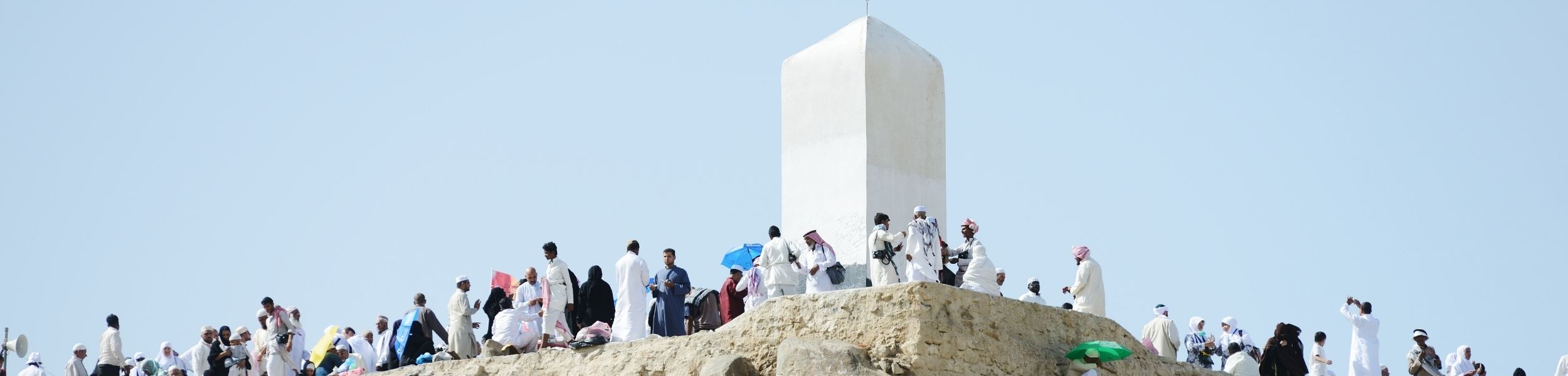
It is a small and modest mountain compared to the imposing mountains that are around. It is made up of large, hard, fragmented rocks, one on top of the other. It is not made of a hard monolithic rock or of a friable rock, which disintegrates into small pebbles. It is located in the east of the territory of `Arafat, in the shadow of the mountain Sa`d. It is 65 meters high from the southern part of its base to its summit.
It is called Mount Ilal, Mount `Arafat, Mount of Mercy (ar-Raħma), Mount of Invocation (ad-Du` ‘), Mount of Walkers (al-Much t), Mount Kabkab and Mount al-Qurayn. Only two names are well attested namely: Mount Ilal and Mount `Arafat.
What it really is
The scholars of the various schools say that there is no particular authentic text about this mount, but that it is the same as the territory of `Arafat. They also said that it is not prescribed to climb it and that it is not concerned by any rite.
The famous Hanafi scholar al-Mull `Al Q r, may Allah have mercy on him, said in the commentary of al-Lub b on page 84: As for climbing the mountain, it is without any (religious) basis. It is rather a testable innovation. He also says on page 224: The best thing is to camp in such a place that one’s presence (`Arafat) is counted as valid, without being careless or lazy. On the other hand, if people go up the mountain, it has no basis. Similarly, staying there before the beginning of the legal time and well after it is also among the detestable innovations.
The Malikite Imam Ibn al-Ħ jib, may Allah have mercy on him, said in enumerating the things that have been innovated by people and that they practice at this mount: Among these things is the fact that they light fires on the mount during the night before the day of `Arafat, that they give great importance to it to the extent that they bring candles to it from their homes, that men and women mingle when they go up or down it, etc. This is a misguidance that makes them look like idolaters in a respectable place like this.
Ach-Shinqiţi, the Malikite, may Allah have mercy on him, said in Ađw ‘ al-bay n (5/263): Know that the ascent of mount ar-Raħma practiced by many of the mass has no basis, has no religious benefit, for there is nothing in the texts that make it a special place, for it is a place that is on par with any other place in the territory of `Arafat. However, the whole territory of `Arafat is validly used as a place of encampment (ritual station).
Al-Juwayn, the Shafi`i, may Allah have mercy on him, said: In the center of the land of `Arafat, there is a mountain called the mountain of mercy. There is no rite that calls for climbing it, even though people have made it a habit to do so.
An-Nawawi, the Shafi`ite, may Allah have mercy on him, said in al-Majmù ` (8/107): Regarding the practice of the people of the mass of giving importance to performing their ritual station on the mount of mercy which is in the middle of the land of `Arafat, as explained above, and the fact that they prefer this particular place over any other place in the land of `Arafat to the extent that some ignorant people among them think that the ritual station is only valid there, all this is an obvious mistake (on their part) and a practice contrary to the Sunnah. No authoritative person has cited any particular ritual to climb this mountain which has the same status as any other place of `Arafat.
Al-Muħibb aţ-Ţabar, the Shafi`ite, may Allah have mercy on him, said in al-Qir , on page 386: Concerning the mount that people are bent on climbing, there is no reliable information or tradition.
Ibn Jam`a, the Shafi`ite, may Allah have mercy on him, said in Hid yatu-s-s lik: What has spread among the masses is : Preferring to perform the ritual station on the Mount of Mercy rather than elsewhere, thinking that it is obligatory to perform one’s station there, gathering on it to perform the station before the prescribed time of the station, lighting candles on it on the eve of the day of `Arafat, The fact that they attach so much importance to it that they bring these candles from their country and the fact that men and women mix during the ascent and descent, all this is a mistake, a proof of ignorance and an evil innovation that appeared after the extinction of the pious predecessors. We pray to Allah to remove it and all other innovations.
Ibn Taymiyya, the Hanbalite, said in Majmù ` al-fatawa (26/133): On the other hand, climbing the mount that is there is not in accordance with the Sunnah… .
He also said in al-Ikhtiy r t al-`ilmiyya (p. 96): By unanimous opinion, it is not among the religious prescriptions to climb the mount of mis ricorde (ar-Raħma). .
Al-Mard w , the Hanbalite, said in al-Inş f (4/29): What is in accordance with the Sunnah is to make the ritual station in the place where the Prophet (peace be upon him) made it, but there is no authentic text regarding the Mount of Mercy (i.e. there is no textual evidence urging one to make one’s station there).
The innovations and offenses committed on this mount by some pilgrims
Some pilgrims are guilty of a number of innovations and offenses on Mount `Arafat because they believe that this mount is sacred or that it has special virtues. Above, the words of the men of science have shown the falsity of this belief. Therefore, in order for the pilgrim to be careful not to fall into these innovations and offences, we mention here some of them:
1- Believing that it is better to perform one’s ritual station on the mount rather than elsewhere in the territory of `Arafa.
2- Performing the şalat and delivering the sermon on the mount.
3- Lighting, on the eve of the day of `Arafat, candles and fires on the mount.
4- Taking with oneself some of the earth of the mount.
5- To rub the beacon [a marker on the top of the mount] and kiss it.
6- Pray towards the beacon.
7- To choose especially to make invocations near the beacon and to raise one’s hands in its direction during the invocation.
8- Shout on the beacon.
9- Turn around the beacon [like the circumambulations around the Kaaba].
10- Tying pieces of cloth on it.
11- Putting written messages on pieces of paper, tufts of hair, coins, pictures or rags in the cracks of the rocks because of various beliefs such as believing that by this act one will come back next time, that by this act such and such a person will make Hajj or that such and such a sick person will be cured or that by this act the woman who has not had a child will become pregnant.
12- Making an appeal from the mount for those who have not yet performed Hajj to do so.
There are other examples of offences and superstitions that Allah does not approve of and for which He has not given His consent.[1]
Source: Islamhouse.com
[1] For more information, see the book: Jabal il l bi-`araf t taħq q t t r khiyya char`iyya by Dr. Bakr ibn `Abdull h Ab Zayd.

