
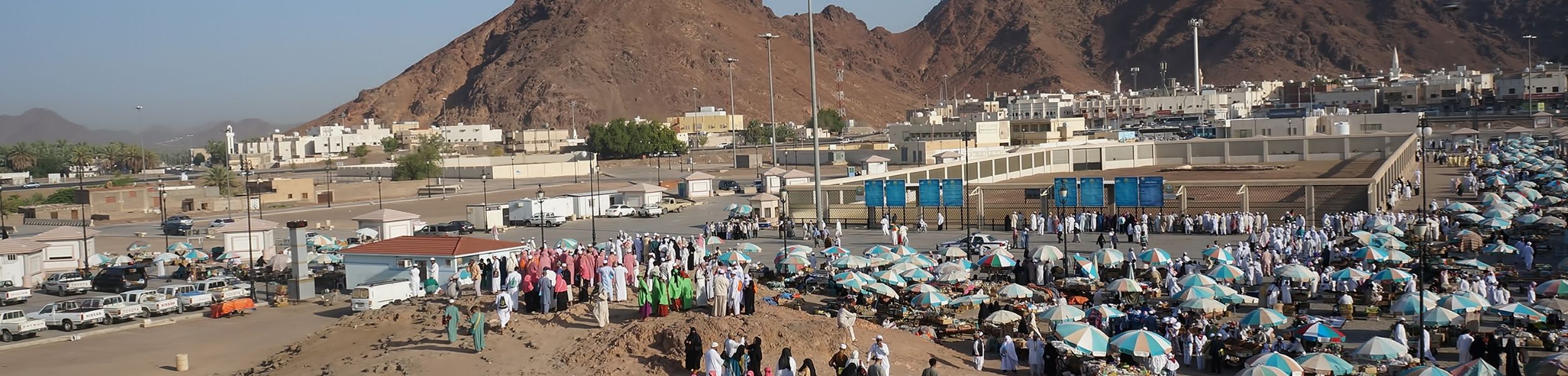
Visit to the Uhud Martyrs’ Cemetery
Its presentation
Uhud: This is the well-known mount in Medina. Today, it is still known by that name. The Prophet (peace be upon him) said of Mount Uhud: « It loves us and we love it. »[1]
There the battle took place in which Ħamza, the uncle of the Prophet (peace be upon him), fell a martyr along with seventy other Muslims. It was there that the incisors of the Prophet (peace be upon him) were broken and there that his noble face was injured. This was two years, nine months and seven days after the hegira (emigration) of the Prophet (peace be upon him) i.e. in 3 H.[2]
The legal permission to visit Uhud and what the visitor says there
Visiting the cemetery of the martyrs of Uhud to greet them and pray for them is permissible, as it is attested that the Prophet (peace be upon him) visited them. Indeed, Ţalħa ibn `Ubaydillâh reports, « We went with the Prophet (peace be upon him). His destination was the tombs of the martyrs. We arrived at the top of the rocky land of Wakim and as we descended the slope, we saw graves at the bend in the valley. We said, « O Messenger of Allah, are these the graves of our brothers? He replied, « These are the graves of our companions. When we reached the graves of the martyrs, he said, « These are the graves of our brothers.
There is no special invocation to be said when visiting these graves. Rather, the invocation (du`â’) that the Prophet (peace be upon him) taught his Companions to say when visiting the cemeteries is to be said, namely: « As-salâmu `alaykum dâra qawmin mu’minîn, wa innâ in châ’allâhu bikum lâħiqûn, yarħamu-l-lâhu-l-mustaqdimîna minkum wa-l-musta’khirîn, nas’alu-lâha lanâ wa lakumu-l-`âfiya » (Peace upon you, O believing inhabitants of this house, we will by the will of Allah join you, may Allah have mercy on the first of you and the next and we pray to Allah that you may be spared from all evil. )
As for women, they are not allowed to visit the graves because of the saying of the Prophet (peace be upon him), « Allah curses [or may Allah curse] those who visit the graves often. »[4].
The martyrs who are buried in Uhud.
According to Jâbir ibn `Abdillâh (may Allah be pleased with him), the Messenger of Allah (peace be upon him) used to use for the men who fell in Uhud the same garment [as a shroud] for two people and would say, « Which one knows the Qur’ân more? » When one of the two was pointed out to him, he would place him in the grave first. Then he would say, « I am a witness for those. He would ask that they be buried stained with their blood. He did not perform the mortuary prayer over their remains, nor did he wash them.[5]
Among the martyrs who were buried in Uħud are: Ħamza ibn `Abdulmuţţalib, Muş`ab ibn `Umayr, `Abdullâh ibn `Amr ibn Ħarâm, `Amr ibn al-Jamûħ, Sa`d ibn ar-Rabî`, Khârija ibn Zayd, an-Nu`mân ibn Mâlik, and others (may Allah be pleased with them).[6]
Ibn an-Najjâr said, « Today, the graves of the martyrs are not known with accuracy except that of Ħamza (may Allah be pleased with him). As for the other martyrs, there are stones laid which are said to indicate their graves… »[7]
Aţ-Ţabarî said, « On the side of Mount Uħud which faces the qibla, are the graves of the martyrs who were killed on the day of the battle of Uħud in the presence of the Messenger of Allah (peace be upon him). The occupants of none of the graves are known except that of Ħamza who was buried with his nephew (his sister’s son) `Abdullâh ibn Jaħch… To the north of Ħamza’s grave are heaped stones which are said to indicate the location of the martyrs’ graves. To the west of the tomb, there are also laid stones which are said to indicate the presence of the tombs of the martyrs, but this is not proven by a reliable transmission. It is said in some books dealing with battles and conquests (maghâzî) that these graves are those of people who died in the year of famine, during the caliphate of `Umar (may Allah be pleased with him). »[8]
The offences that one should be careful not to commit.
The visitor should try to follow the Sunnah of the Prophet (peace be upon him) during his visit and be careful not to fall into that which contradicts it and which will cause him to sin or diminish his reward. In the following, we mention some of the offences that some visitors are guilty of, so that the person who makes visits does not commit them in turn:
- Visiting the martyrs of Uħud especially on Thursday.
- Imploring the martyrs of Uħud and especially Ħamza or asking for their help or making vows to them (i.e. promising to do something in their honor).
- Making a special invocation when visiting the grave of Ħamza (may Allah be pleased with him) or the other martyrs of Uħud.
- The fact that some visitors stand with their heads bowed, both hands on or below their navels and other attitudes that resemble the posture that one adopts in the şalât.
- Throwing grain, food or money into the graveyard or surrounding squares.
- The mixing of men and women with all the temptations that this brings.
- Women visiting the cemetery.
- Tying rags on the window overlooking the place where the martyrs are.
- Screaming and crying at the graves of the martyrs.
- The fact that some visitors will seek baraka by climbing the Mount of the Archers, where the ground was trodden by some of the Companions (may Allah be pleased with them).
- Attracting baraka by means of the stones on the Mount of Archers or praying towards them or prostrating on them.
- Going to the caves of Mount Uħud to tie pieces of cloth in them while making invocations not permitted by Allah and imposing hardships on oneself for this purpose.
- Visiting certain places that are claimed to contain the traces of the Prophet (peace be upon him), such as certain rocks.
- Source: Islamhouse.com
[1] Reported by al-Bukhari (1411) and Muslim (1365).
[2] See Mu`jam al-buldân (1/109), the index of places mentioned in the Şaħîħ of al-Bukhârî by Sa`d al-Junaydil p. 19 and the Atlas of the Hadiths of the Prophet by Dr. Chawî Abû Khalîl p. 23.
[3] Reported by Imam Aħmad in al-Musnad (1/161) and by Abû Dâwûd in number 2043. Ibn `Abdulbarr said in at-Tamhîd (20/245), « This is a hadith whose chain of narration is good. »
[4] Reported by at-Tirmidzî (3/372).
[5] Reported by al-Bukhari (1347).
[6] Al-Maghâzî of al-Wâqidî.
[7] Ad-Durra ats-tsamîna pp. 98 and 99.
[8] At-Ta`rîf pp. 125 and 126.

