
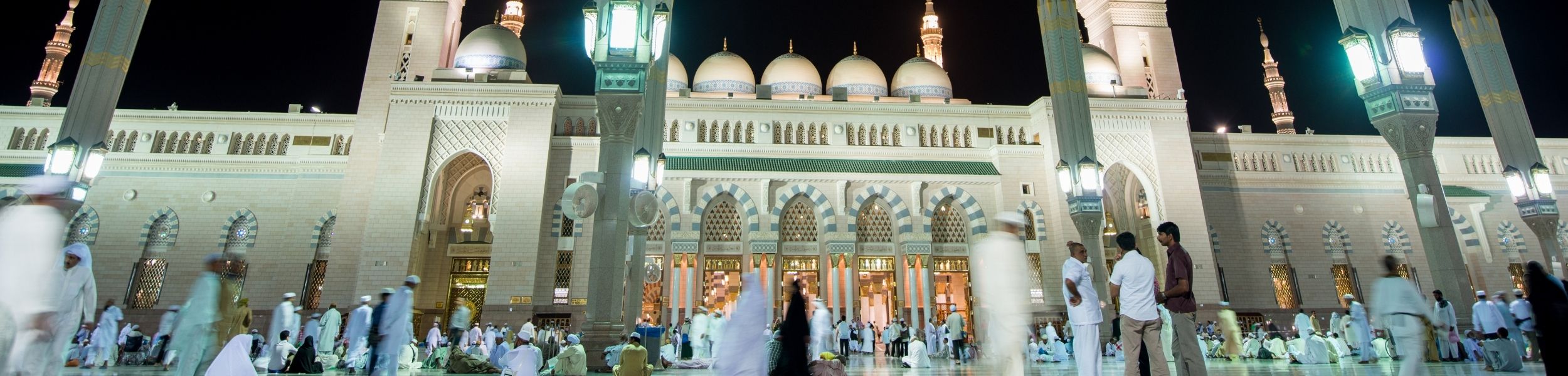
Here is a summary of the merits of Medina, the city of the Prophet (r). It is the city of the Noble Messenger (r), the pure of the pure, the place that received the Revelation and the visit of the Angel Jibril to the Prophet (r), the refuge of faith, the home of the believers, the first capital of the Muslims, From where the banner of the struggle on the path of Allah was raised, from where the messages of truth were sent out to bring people out of darkness and into light, from where the light spread and illuminated the whole world. It is the place of emigration of the Prophet (r), the place where he emigrated, where he lived the last part of his life, where he passed away and where he was buried. On the Day of Resurrection, he will be resurrected there, and his grave will be opened before anyone else’s. Apart from his grave, the exact place where the Prophets are buried is not known.
Allah has honored this city and endowed it with certain merits. It is the best place that can be outside Mecca as confirmed by the Hadith that the Prophet (r) addressed his hometown from afar on the day of his exile:
« By Allah! You are the best land of Allah and the most beloved land of Allah! If I were not forced to leave you, I would never have done so. »[1]
– Allah (I) made it sacred just as He made Mecca sacred. The Prophet (r) said in this regard, « Ibrahim made Makkah sacred, and I made Medina sacred. »[2]
This Hadith should be taken in the sense that Muhammad and Isma’îl’s father announced the sanctification of these two cities, not that they made them sacred themselves since it is Allah alone who makes a given place sacred. Moreover, contrary to popular belief, there are only two holy cities: Medina and Mecca. Thus, it is not appropriate to say that El Quds is the third holy place of the Muslims, but rather that it is the third mosque of the Muslims.
Indeed, these three buildings have a certain merit as formulated in the Hadith: « There is no ritual journey to be made except for three mosques: the Holy Mosque, my mosque, and the Aqsa Mosque. « [3] It is also not appropriate to say that only the Prophet’s (r) mosque is sacred, but rather sacredness embraces the whole city whose boundaries are mentioned in the Hadith: « Medina is sacred between the mountains of ‘Aïr and Thawr. »[4]
The Messenger of Allah (r) also stated, « I have made Medina sacred between its two volcanic plates; it is not permissible to cut its plants or hunt its animals there. »[5] Thus, any building outside these boundaries does not enter the sacred space although it is part of the city.
– The Prophet called it Taiba (the pure) and Taiba. The Lord himself called it Tâba as revealed in the Hadith: « Allah called Medina Tâba. »[6]
– 6] Madinah is a refuge for faith according to the Prophetic saying: « Faith takes refuge in Madinah as a snake takes refuge in its hole. 7] According to the Hadith, faith is directed towards Madinah and the hearts of Muslims are attached to it.
– Madinah is the city that devours other cities as the Prophet (r) explained: « I have been ordered (to go into exile) to a city that devours other cities. People call it Yathrib, but it is Medina. »[8]
There are two possible explanations for this Hadith; either Medina defeats and subjugates the other cities or the spoils collected during the wars on the path of Allah are deposited there. History shows that both of these events occurred. Madinah is the source of the reformers of the world and the conquerors of the cities who brought people out of darkness into light by the Will of the Almighty. The Messenger of Allah predicted that the Holy City would take the treasures of the Persian and Roman empires. This prophecy was fulfilled during the Khalifate of ‘Omar (t).
– The Prophet (r) enjoined to endure the poverty and difficult conditions that one may encounter in Medina. When some of its inhabitants wanted to migrate to the fertile lands and rich cities, he (r) exclaimed, « Medina is better for them if they knew. Allah replaces anyone who is happy to leave it with a better one. I would intercede or witness on behalf of anyone who endures indigence and adversity there. »[9]
– The Messenger of Allah (r) formulated that it was honorable and that it was extremely serious to cause anything in it through his words, « Madinah is sacred between the mountains of ‘Aïr and Thawr. Whoever introduces anything evil into it, will receive the curse of Allah, the angels, and all men. Allah will not accept anything from him (on the Day of Resurrection). »[10]
– The Prophet (r) invoked Baraka on his behalf saying, « O Allah! Bless our crops, bless our Medina, bless our Sa’, and bless our Mud (units of measurement). » [11] (It is noteworthy in particular that he asked for more Baraka in favor of Madinah than Ibrahim asked for in favor of Mecca).
– Plague and Antichrist do not reach its walls according to the Hadith: « Angels stand at every entrance to Madinah; plague and Antichrist cannot enter it. »[12]
– The Prophet (r) severely warned against harming its inhabitants saying, « Allah melts like salt melts in water whoever wants to harm the inhabitants of Madinah. »[13]
– When the Prophet saw the walls of Madinah in the distance on his way back from a journey, he would quicken the pace of his horse[14] He also made the following invocation, « O Allah! Make us love Madinah as we love Mecca or more… and move its fever to el Ju’fa. »[15]
– The Prophet (r) said, « Whoever can die in Madinah let him do so, for I will be the intercessor of whoever dies in Madinah. »[16]
– The Prophet (r) said regarding certain dates in Madinah, « Whoever eats seven dates of el ‘Ajwa every morning, he will be immune that famous day from poison and sorcery. »[17]
In terms of worship, Madinah enjoys certain merits. Among others, the reward of praying in the Prophet’s (r) mosque is multiplied as confirmed by the Hadith:
« One prayer in my mosque is better than a thousand prayers in any other mosque besides the Sacred Mosque. »[18]
(A prayer in Mecca is worth one hundred thousand prayers, while a prayer in el Aqsa is worth two hundred and fifty prayers according to a Hadithauthentic and not five hundred as assumed by some annals whose narrative chain is weak). This applies to both supererogatory and obligatory prayers. If the mosque is full of worshippers, it is possible to pray in the surrounding streets and enjoy the reward of congregational prayer without the reward of a thousand prayers reserved for one who prays within its walls. In the heart of the mosque, there is a privileged place as the Prophet indicates: « Between my house and my minbar (not: « between my house and my grave » as some invented annals suggest), there is a garden of Paradise. »[19] It is therefore more appropriate to engage in certain rituals (Dhikr, reading the Qur’an, supererogatory prayer) in that very place, apart of course from the service during which the front rows should be preferred. [20]
Upon arriving in Madinah, one should go to the Mosque of the Prophet (r) to pray two rak’a or even more. The Prophet (r) said: « Whoever enters our mosque to learn or teach a good thing, he is like a warrior on the path of Allah. And whoever enters it for something else, he is like the one who covets with his eyes that which does not belong to him »[21].
It is also appropriate to perform I’tikaf[22] if the opportunity arises. It is also possible to greet the Prophet (r) and his two companions who are buried near him (one comes to Madinah with the intention of visiting the Prophet’s (r) mosque, not his grave, although it is permissible to do so on the spot; one must distinguish the nuance). It is recommended that the visitor perform the prayer in the Mosque of the Prophet (r) often, given the merit of doing so, as long as he does not stay long in the Holy City. However, the rumor that one should stay there for eight days to perform forty ritual prayers is subject to discussion. It is true that there is a Prophetic Proposition that emphasizes this: « Whoever performs forty prayers there, he will be immune to Hell and hypocrisy.
However, this Hadith is not considered authentic by scholars. Therefore, it cannot be used here as an argument. It is reported by an individual who is not reputable in the field of Hadith. Moreover, the scholar who judged its reliability is not a reference in the event that he is the only one to support it. In short, the Hadith is weak; one cannot rely on such rumors to establish a law. The visit to Madinah is therefore not subject to a fixed time limit. One can spend as little as one hour or as much as one can stay for a day or more (on the other hand, visiting Madinah is not part of the rites of pilgrimage, so one should not take into account the false annals on the matter).
Furthermore, it is recommended that the visitor goes to the Baqi’ cemetery to pray for its occupants, and to implore Allah’s grace and forgiveness for them. It is also recommended to visit the martyrs of Uhûd Mountain to do the same (the Prophet (r) said concerning Uhûd: « This mountain loves us and we love it »[23]). (The Prophet (r) said: « Whoever purifies himself at home and then goes to the mosque of Quba to perform the prayer, he will have the reward of an ‘Umrah.
It is strictly forbidden to perform Tawaf around the grave of the Prophet (r). (The Prophet (r) said: « Do not make my grave a place of ceremony, but pray over me from where you are, for your prayers are passed on to me.) It is important to know that Tawaf is an act of worship that should be dedicated exclusively to Allah and should only be performed around the Ka’ba.[26] By performing it around the grave of the Messenger (r) or another out of devotion, the individual becomes a pagan for associating a creature with Allah in worship, although his intention is to obey Him. If, however, he is content to perform Tawaf around his grave for the sake of his Lord and out of devotion to Him, this innovation, though reprehensible, does not await the degree of apostasy.
In this respect, it is inconceivable to engage in this kind of practice in other places around the world such as the so-called tomb of Husain, or that of Badawî in Egypt, of Ibn ‘Arabî in the region of Shâm, of Sheïkh ‘Abd el Kâdir el Jilânî and of Mûsa el Kâthim in Iraq, etc. It is very important to distinguish between visiting a dead person and worshipping Allah exclusively. Worship belongs to Allah (U) only, while visiting a grave has only a moralizing scope, it helps to meditate on death, on the other world, and to lose interest in this world. The visit should be devoted to invoking and soliciting divine mercy on behalf of their occupants. On the other hand, it is strictly forbidden to devote any act of association to them such as worshipping other than Allah (U), imploring them, asking for help, etc.[27]
May the prayers of Allah and His Salvation be upon Muhammad, as well as upon his relatives, and all his companions!
Source: Islamhouse.com
[1] The Hadith is authentic and is reported by e-Tirmidhi and ibn Mâja.
[2] Reported by Muslim.
[3] Reported by Bukhari and Muslim.
[4] Reported by Bukhari and Muslim.
[5] Reported by Muslim.
[6] Reported by Muslim.
[7] Reported by Bukhari and Muslim.
[8] Reported by Bukhari and Muslim.
[9] Reported by Muslim.

